
August 11, 2020 ~ First Meeting. The journey for “I Am Home” began.
“I Am Home” is not only a curator-artists collaboration, but a chance of “human correspondence” between individuals of different genders, faiths and ethnicities in search for the meaning of “home” in a multicultural Malaysia.
For this pilot phase, we proposed to document memories of 20 individuals from different parts of Penang. The plan is to interview people whose families have settled down in a place for generations. From the memories, the team will then brainstorm ideas that can visually depict the meaningful relationship between people and place. In another word, the produced drawings aim to convey a “sense of home”, or “a sense of belonging” at a specific locality in Malaysia. To kick start the process, during our first meeting we wrote down a wish-list of people whom we wanted to feature. The intention was to curate a multicultural lineup. The choices were based on our personal interests, although we might not have any clue of how to get the contacts. The preliminary entries looked something like these:- Malay, farmer, location??- Chinese, occupation??, George Town- Indian, milkman, location??- Who??, fisherman, location??- Who??, occupation??, Penang Hilletc. etc. etc.We planned to use the snowball technique by first looking for someone we know personally, then ask him/her for recommendation in order to get to the “profile” whom we desired. This seemed like a workable plan, but in reality things don’t always follow the plan…..

August 13, 2020~ Interview #01 (part 1)
For our first interview, Bagan boy Azmi Hussin brought us to his hometown, and introduced us to Pak Non. None of us knew Pak Non’s family background before, so we went to him assuming that the family must have pursued some form of traditional Malay livelihood before, such as farming. We were wrong. Pak Non’s father was a school headmaster and he himself is a retired custom officer. Although he did not fit into our preliminary wish-list, Pak Non was no less intriguing and special. His memories living and working closely to the sea revealed to us a different sense of place and belonging that is uniquely Bagan Dalam.

August 13, 2020~ Interview #01 (part 2)
Multimodal documentation. During the interview session, while the curator used audio recording to document Pak Non’s life experience, the artists produced life sketches to capture their immediate impressions. What started as an ad-hoc attempt has become the SOP for the entire project.

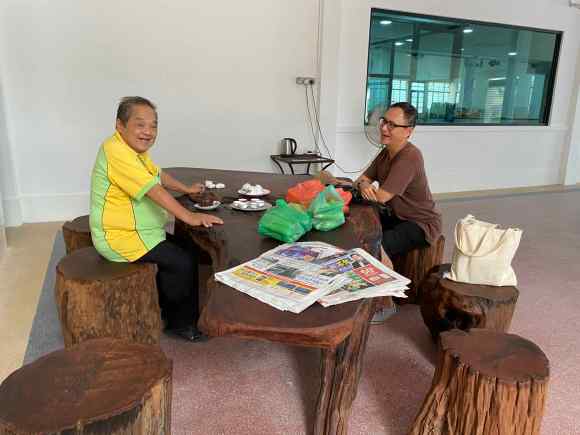
After interview with Pak Non, Azmi brought us to one of his regular eateries in Butterworth, a traditional Chinese-run halal beef noodle stall near Jeti Lama. Over the meal, we exchanged views on food consumption in relation to religion and social norm. We talked open-mindedly and sincerely, and the conversation has helped to clear some doubts and brought us closer.

Little did we know that our unplanned muhibah get-together that day was being photographed and used to illustrate a Star newspaper article on Malaysia Day. Indeed, the intention of “I Am Home” is to celebrate the true spirit of being Malaysians.

August 13, 2020 ~ Interview #02
After lunch at Butterworth, we decided to travel south to Nibong Tebal, to look for an old Gujerati textile shop owner whom Azmi has contacted few years back. We were not sure if he would still be there, nonetheless we decided to visit this charming small town which all of us were unfamiliar with. It was rather a long drive on the highway. We had the opportunity to talk and learn more about each other. In the process we developed deeper understanding about our different cultural identities. This way, the journey of “I Am Home” is not only about searching for narratives from different people, it is also as much about self definition. Upon arrival, Azmi had difficulty identifying the shop. Later we found out that actually the shop had closed down and the man had migrated. We then decided to explore the “High Street” (the only main street) of Nibong Tebal on foot. Without any expectation we walked on the street. Eventually we were caught by surprise when we accidentally found our “emas”! This is the beauty of working on the ground. You can never expect what is coming next.

Almost towards the end of our walk, we were drawn by the aroma from this traditional bakery. There was an old man sitting in front of the shop and the shopkeepers were busy moving freshly baked loafs out of the oven. What started as a casual greeting became an in-depth interview in-situ. Our “emas” discovery, Mr. Kee, turned out to be an active local leader who had involved in many community and social works for decades. Old timers of Nibong Tebal, regardless of race, would know him as “penghulu”. Our gratitude to Mr. Kee for patiently sharing his memories to this group of “strangers”.Tips for anyone working in the field of community and culture: The squatting posture may be uncomfortable, but in this situation, it is a polite gesture when talking to an elderly person. In an Asian culture, respect for the elders is an essential quality. It will make a difference in the dynamic of human correspondence.
August 17, 2020~ Interview #03
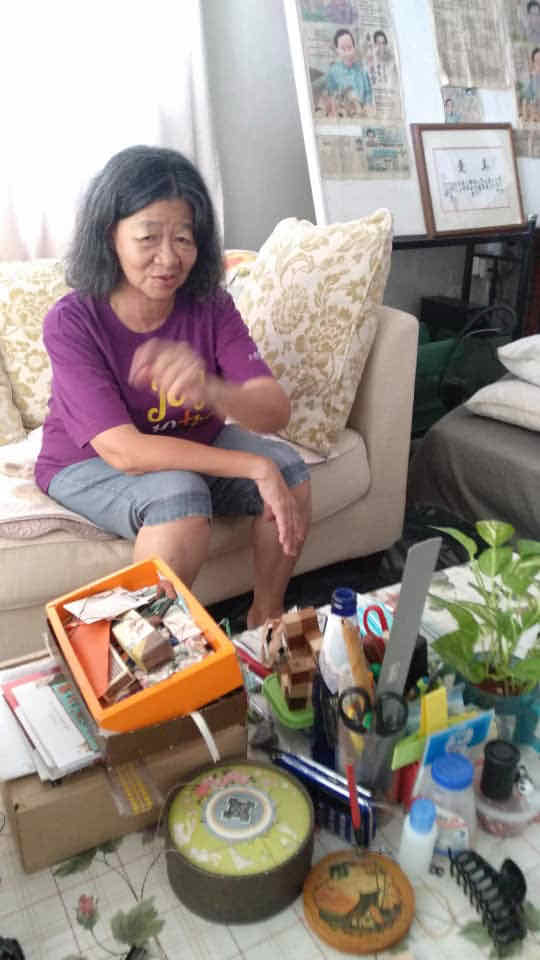
This time, it was the Air Itam boy Lefty Julian’s turn to bring us back to somewhere near to his childhood place. Julian introduced us to Mdm. Chun, who grew up in a close-knit hillside dwelling community at Paya Terubong. Her stories of trailing behind her rubber-tapper father every morning were vivid examples of place-based learning and transmission of local wisdom. E.g. she was taught ways to differentiate edible and non-edible plants, search for fresh water source, hunt for the rare and extremely delicious wild mushroom etc. Today, although Mdm. Chun has moved to the “lowland”, she still enjoys hiking because sometimes she is able to find some familiar wild plants. She will then transplant it back home in order to grow and enjoy a piece of “the good old taste”.

August 27, 2020~ Interview #04
Next, we came to the charming Berapit village to meet Coach Teh, or more famously known as the mentor of Malaysia’s badminton legend Lee Chong Wei during his schooling days.In his 80’s, Coach Teh is still grooming young badminton talents tirelessly. Over the years, badminton players and coaches within Malaysia and from other countries had come to train with Coach Teh in this unassuming school hall in a new village. He said, “to be a great player, natural talent is secondary. The most important quality is a person’s attitude to learn and strive”. Seemingly, despite the physical environment, what makes a place special is the quality of its people.
September 1, 2020~ Interview #05
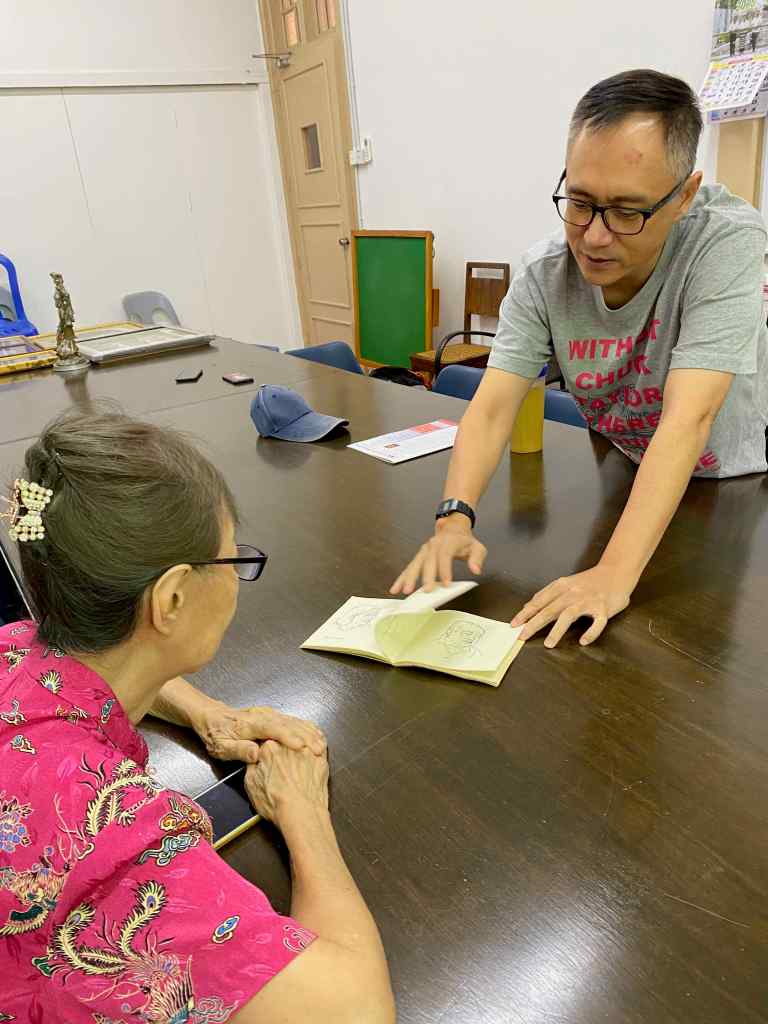
Thank you Mdm Wong Chiew Lee from the State Chinese Penang Association for connecting us to Aunty Oon, our fifth interviewee. We went to Aunty Oon with a preconception that we would be meeting an “authentic Nyonya”, someone who has lived an exotic lifestyle like those in the “Little Nyonya” drama series. After talking with Aunty Oon, we realised that she was nothing close to our stereotypical image of a Nyonya. This has reminded us that people do not live in a frozen past, life evolves so is a person’s identity. Born in the late 1930s, Aunty Oon’s stories revealed to us that the Baba Nyonya community was already modernised and westernised at that time. Unlike their ancestors, her generation was also well assimilated into the larger Chinese community. For her at least, she did not consciously differentiate herself from the other Chinese. It was not until the late 1980s that the Penang Baba Nyonya community began a concerted effort to rediscover and promote their heritage. This was the result of the first Baba Convention held in 1988, where the Baba Nyonya communities from Penang, Singapore, Melaka gathered in Penang. “We had to dig out our grandmother’s kebaya and learnt form the elders how to don the costume and hairdo properly.
For more project updates, please follow our Facebook page.
 I Am Home